Make room for the unfinished thought
A pause is not always permission to act.
People pause to find a word, change their minds, or add the part that matters. An assistant that treats every pause as an endpoint makes the person work around its timing.
I was the lead designer for a nascent Speech team at Google. My work covered interruption, partial fulfillment, and helping people speak at their own pace. Two decisions capture the problem: how to show an unfinished request, and how long to leave room before acting.
Read the original Google speech account
Two decisions from the original work
- Adjust the listening endpoint. Pause fulfillment and keep listening when an utterance appears unfinished. Show tentative state in the interface rather than presenting the partial interpretation as final.
- Buy time before an irreversible action. Show that a call is being prepared, but hold the actual call for two seconds so the person has a chance to continue or correct it.
Try the timing decision
“Add dried mango … with no sugar added.” Act at the pause and the person has to repair the request. Wait without feedback and they may wonder whether they were heard. My current recommendation is to hold the change, make listening visible, and ask a specific question if the pause continues.
- Finish a thought compares immediate action, quiet waiting, and acknowledgment.
- Leave room for a qualifier follows “Add dried mango … with no sugar added.”
- Repair an early response shows the extra work created when the assistant acts too soon.
A separate question: how should it sound?
These two stock voices read the same script in my current VoiceEnroll prototype. Listen for the difference in delivery. This is an illustrative voice audition, separate from the historical work and the timing studies above.
Candidate A
Candidate B
Transcript for both clips: “Hello. This is a sample of how I sound. You can pick the voice that fits you best, and change it any time.”
A comparison instrument, not a verdict
I built a voice-comparison tool that lays candidates side by side with the same script, pitch contours, waveforms, spectrograms, and synthesis cost. That structure makes a difference easier to locate and discuss without pretending the chart decides which voice is right.
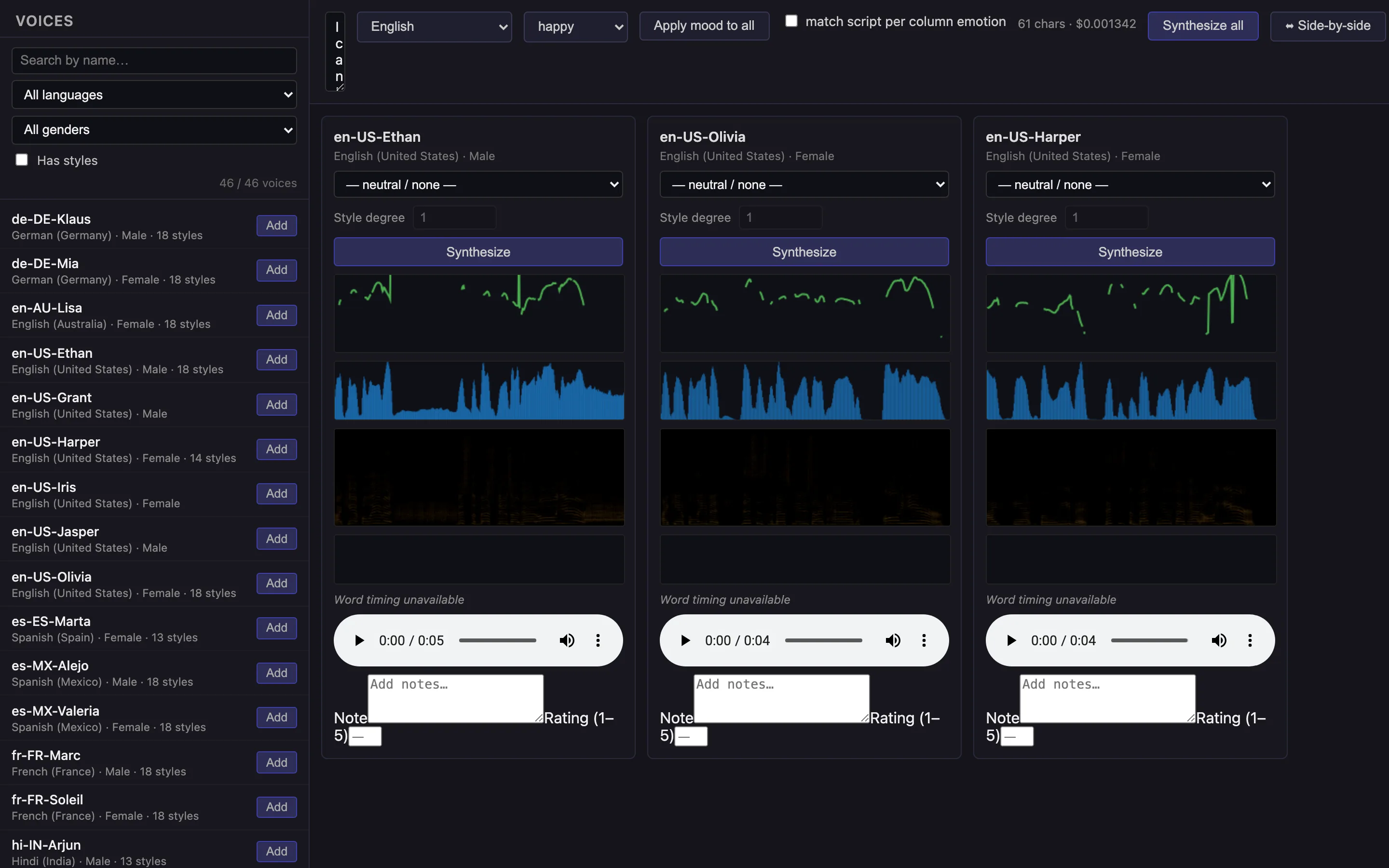
Pitch tracks can point to a pause or contour worth hearing again. They cannot establish warmth, trust, or fit for a task. That judgment needs listeners in the relevant context, with interruption and recovery included in the test.
Copilot Vision
I helped ship vision for Microsoft Copilot. Over the past year, my role has been Voice AI Designer.
Sources, conditions & what remains to test
Evidence still needed: listener observations from a matched, task-relevant evaluation; the selection criteria and final product decision; and documented outcomes. The clips above demonstrate a comparison method, not a winning voice. The earlier studies do not establish how these two synthetic voices perform in use.
Separate contemporary reference: Siri recording study.